
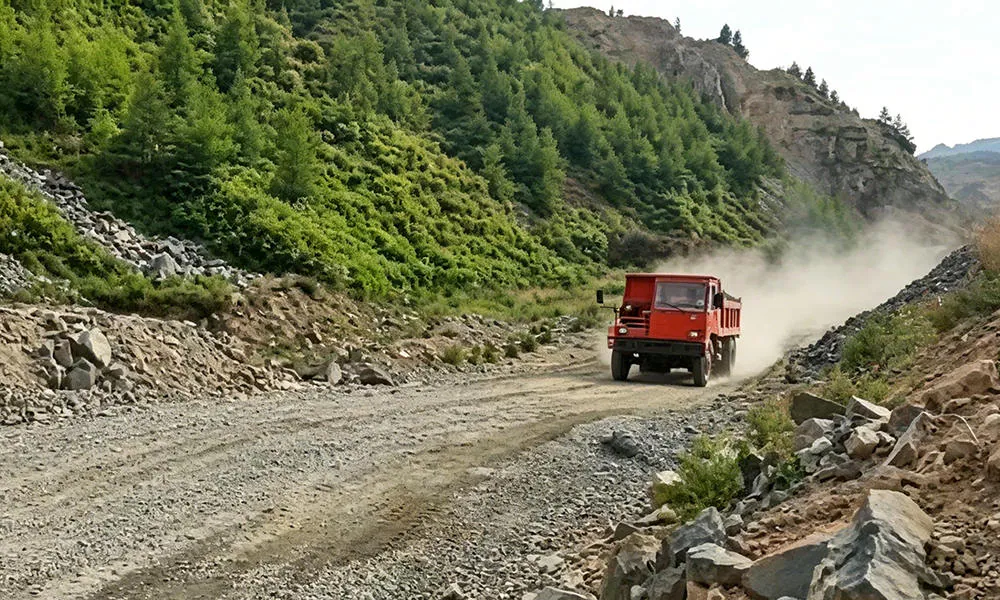
An equipment inquiry is more useful when it describes the route as well as the required payload. A photograph can show a general setting, but it cannot establish measured clearance, road condition or a vehicle’s capability on that route.
Map the full travel path
List the route from loading to discharge and back. Note the narrowest width and height, turning areas, intersections, passing points and any areas where the truck must stop or reverse. Include the dimensions of entrances and transitions, not only the typical tunnel section.
Describe gradients and surface conditions
Record the grade and approximate length of each ramp or sloped section, plus changes in surface condition such as loose, wet, uneven or maintained areas. If the route changes by season, shift or production phase, describe those variations. Grade and surface information should be evaluated together with model-specific powertrain, tire and braking data.
Include distance and traffic arrangement
Approximate loaded and empty travel distances, traffic direction, passing arrangements and loading or discharge positions help explain how the route is used. These details are inputs for an engineering discussion; they do not by themselves predict cycle time or output.
Compare measured information with the exact vehicle
Ask for dimensional and operating information for the precise model and configuration under review. Confirm turning requirements and any grade or braking information under stated test conditions. The mine’s own design, operating rules and destination requirements also need to be considered by the appropriate technical personnel.
Route information to gather
- Minimum route width and height, including entrances and transitions.
- Turn geometry, intersections and locations with restricted maneuvering space.
- Grade, length of each ramp and surface conditions along the route.
- Loaded and empty distances, traffic flow, loading position and discharge area.
- Known operating or regulatory constraints for the mine and destination.
For general context, ISO 19296:2018 covers safety requirements for self-propelled mobile machines used underground. Its reference here is not a statement that any HUAYI product is certified or compliant; confirm which requirements apply to the machine and market with the manufacturer and qualified local advisers.